

HighFEM
High Frequency Earthquake Modelling
Abstract
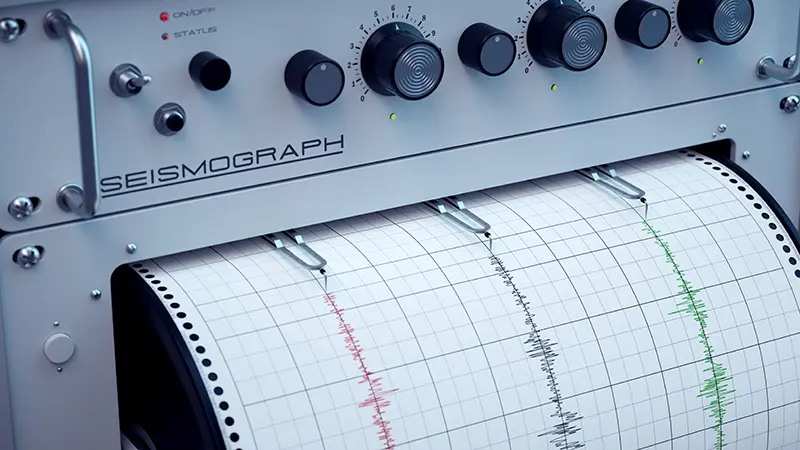
Earthquakes are among the most devastating natural hazards humanity is confronted with. Earthquake shaking spans a very wide range of frequencies, with classic sensors designed to record signals over four orders of magnitude in frequency. The low frequency part of seismic signals is readily used to study earthquake processes and the interior structure of the Earth. Using the high frequency parts of earthquake wavefields, on the other hand, is more challenging, because i) high frequency signals are hard to observe: seismometers are usually too far away and too sparse to record high frequency wavefields with the necessary resolution; ii) high frequency wavefields are hard to model: the computational cost of wavefield simulations grows with the 4th power of frequency, and we lack the detailed knowledge of underground geological structures that affect and modify the signals at this small scales. Next level underground laboratories, such as ETHZ’s Bedretto Lab or Utah Forge, however, strongly reduce the observational limitations, in that they facilitate earthquake monitoring from unusually close distances, and with high sensor densities. Here we propose to use this opportunity, and to jointly leverage high performance computing, generative deep modeling and the massive, near-field earthquake data sets that the novel laboratories provide, to model and study earthquake waveforms up to very high frequencies. We will use these modelling capabilities to achieve a range of science goals, including improved seismicity monitoring algorithms, and to study small scale earthquake source processes and ground motion site response.
People
Collaborators

Salman Mohebi, PhD, received his doctorate in Information Engineering from the University of Padova, Italy. As a Marie Curie PhD fellow within the ITN-WindMill project, he delved into the intersection of machine learning and wireless communications, probing the frontiers of technological innovation. He was a visiting scholar at Telenor Norway in 2021 and SDSC ETH Zurich in 2022, gaining expertise in telecommunications and data science. Currently, Salman serves as Senior Data Scientist at SDSC, channeling his skills towards the design, development, and optimization of large-scale deep learning models. His primary focus lies in handling extensive multi-dimensional datasets, particularly in the realms of climate and weather modeling.


Steven Stalder joined the SDSC in 2022 as a Data Scientist in the academia team. He received both his BSc and MSc in computer science from ETH Zürich, with a main focus on machine learning and high-performance computing. His first contact with the SDSC was during his master’s thesis, where he worked on explainable neural network models for image classification. Outside of work, Steven loves playing football, reading an interesting book, or watching a good movie.

Simon joined the SDSC as a senior data scientist in April 2022. He conducted his doctoral research on statistical modeling of high-dimensional genetic data at ETH Zürich and earned his MSc and BSc degrees in computer science from the Technical University of Munich. His research interests lie broadly in probabilistic machine and deep learning, generative modeling, causal inference, and approximate inference. Simon is an avid open-source software contributor, with a particular enthusiasm for probabilistic programming languages and numerical computing.
PI | Partners:
ETH Zurich, Department of Earth Sciences:
- Dr. Men-Andrin Meier
- Dr. Kadek Palgunadi
- Dr. Laura Ermert
- Dr. Maria Koroni
In close collaboration with our SDSC intern Andreas Bergmeister
description
Motivation
The prime observation to study earthquake phenomena are seismic waveforms. Inferences
on earthquake sources and earth interior structure are made by comparing them to increasingly sophisticated numerical models. A current gap in our capabilities is the generation of realistic high
frequency (HF) synthetic seismic waveforms. The computational cost of deterministic physics-based
waveform simulations puts limits to the resolvable frequency range. Moreover, detailed modelling
of high-frequency waveforms requires considerable prior geologic knowledge, such as gradients and interfaces between rock types, cracks and shear zones, and fine-scale topography.
Proposed Approach / Solution
For the project HighFEM, we are developing generative models for synthesis of seismic waveforms. Since waveforms are long-range time series data sets, approaches based on forecasting methods, such as recurrent neural networks and autoregressive models (e.g., LSTMs or pixelCNNs), combined with adversarial training (e.g., GANs) pose a promising research direction.
Impact
The project will allow to better characterize and understand natural and induced earthquakes; to study earthquake rupture, including at small scales; and to improve site-specific seismic hazard estimates.
Presentation
Gallery
Annexe
Additional resources
Bibliography
- Florez, Manuel A., et al. "Data‐driven synthesis of broadband earthquake ground motions using artificial intelligence." Bulletin of the Seismological Society of America 112.4 (2022): 1979-1996.
Publications
Related Pages
More projects
Merck: cancer care adverse events
Èvokâ: Enhancing Fribourg's Archives
ACROSS
Dedgeflow
More projects
News
Latest news
La science des données au service de la neutralité carbone du canton : ENERBAT ouvre la voie
La science des données au service de la neutralité carbone du canton : ENERBAT ouvre la voie
The SDSC to support 31 projects through its second National Calls
The SDSC to support 31 projects through its second National Calls
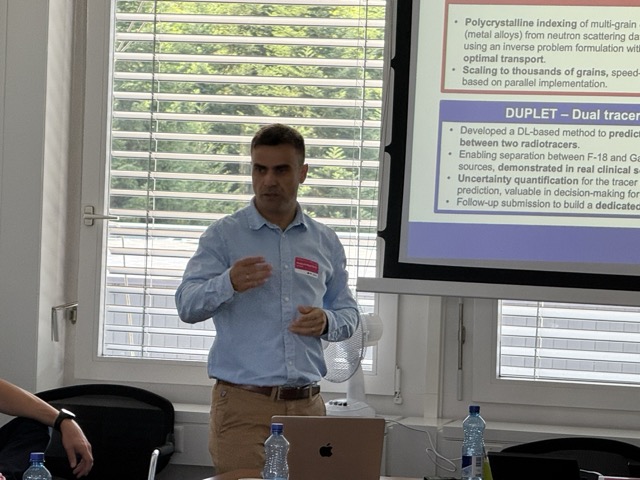
SDSC and PSI teams jointly explore the AI potential of large-scale infrastructures
SDSC and PSI teams jointly explore the AI potential of large-scale infrastructures
Contact us
Would you like to explore how we can work together?
Our team of data scientists and professionals looks forward to engaging in impactful, results-driven collaborations with you.