

FLBI
Feature Learning for Bayesian Inference

Abstract
The goal of this project is to use machine learning to find low-dimensional features in high-dimensional noisy data generated by stochastic models or real systems. In the first case, we are interested in the features imprinted on simulated data by the parameters of the stochastic model. In the latter, the interesting features depend on the particular system. In hydrology, one of the domains considered in this project, they are fingerprints of catchment properties in observed time-series of river-runoff. In astrophysics, another considered domain, the features are the parameters of solar dynamo models that govern the magnetic field strength of the sun. In each case, the problem is to disentangle the effect of high-dimensional disturbances from the effects of relevant characteristics (i.e., parameters, fingerprints, etc.). This problem is reminiscent of the problem of finding collective quantities characterizing states of interacting particle systems in statistical mechanics. Variational autoencoders, have been proven to be capable of learning such quantities in the form of order parameters or collective variables, which could then be used to, e.g., enhance Markov chain Monte Carlo samplers or molecular dynamics simulations.
People
Collaborators

Simon joined the SDSC as a senior data scientist in April 2022. He conducted his doctoral research on statistical modeling of high-dimensional genetic data at ETH Zürich and earned his MSc and BSc degrees in computer science from the Technical University of Munich. His research interests lie broadly in probabilistic machine and deep learning, generative modeling, causal inference, and approximate inference. Simon is an avid open-source software contributor, with a particular enthusiasm for probabilistic programming languages and numerical computing.


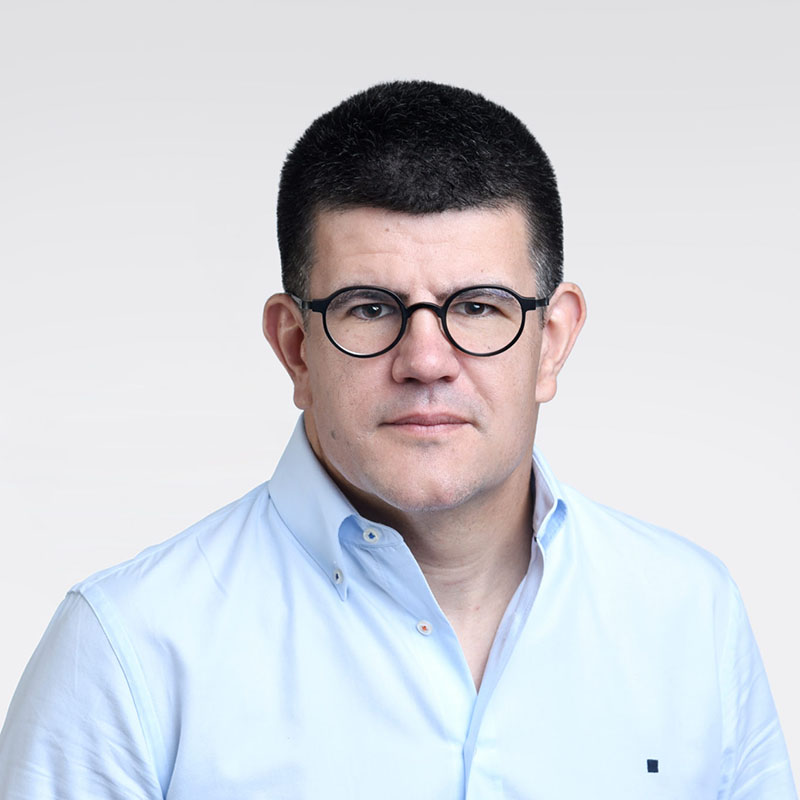
Fernando Perez-Cruz received a PhD. in Electrical Engineering from the Technical University of Madrid. He is Titular Professor in the Computer Science Department at ETH Zurich and Head of Machine Learning Research and AI at Spiden. He has been a member of the technical staff at Bell Labs and a Machine Learning Research Scientist at Amazon. Fernando has been a visiting professor at Princeton University under a Marie Curie Fellowship and an associate professor at University Carlos III in Madrid. He held positions at the Gatsby Unit (London), Max Planck Institute for Biological Cybernetics (Tuebingen), and BioWulf Technologies (New York). Fernando Perez-Cruz has served as Chief Data Scientist at the SDSC from 2018 to 2023, and Deputy Executive Director of the SDSC from 2022 to 2023
description
Motivation
Computational Bayesian inference of parameters or summary statistics is complicated in high-dimensional parameter- or data-spaces. In that case, conventional methods, such as approximate Bayesian computation or sequential Monte Carlo versions thereof, fail to infer correct posterior distributions for a measurement which necessitates the development of efficient methods for these scenarios. A recent approach utilizes deep learning to approximate posterior distributions with neural networks, however, these approaches still do not scale well to high-dimensional data, such as time series data of the magnetic field of solar cycle.
Proposed Approach / Solution
For this project, we develop novel methods for high-dimensional approximate inference, both in parameter- and data-space, utilizing recent developments in neural density estimation and dimensionality reduction. We a) propose several theoretical approaches to solve high-dimensional approximate inference and b) develop high-quality Python libraries implementing these algorithms for applied researchers to use.
One of our recent methods, which we call surjective sequential neural likelihood estimation, uses dimensionality-reducing normalizing flows to more efficiently estimate probability densities which allows for increased accuracy in inferring posterior distributions. On several experimental benchmarks our method outperforms baseline methods while being more computationally efficient w.r.t. the number of trainable parameters and computational speed (Figures 1 and 2).
Impact
We expect of our methods to be of great value for Bayesian inference, since current methodology is not suitable for high-dimensional time series data, for instance time series observations from solar dynamos or other ODE/PDE-models.


Presentation
Gallery
Annexe
Additional resources
Bibliography
- Albert, Carlo, Hans R. Künsch, and Andreas Scheidegger. "A simulated annealing approach to approximate Bayes computations." Statistics and computing 25 (2015): 1217-1232.
- Greenberg, David, Marcel Nonnenmacher, and Jakob Macke. "Automatic posterior transformation for likelihood-free inference." International Conference on Machine Learning. PMLR, 2019.
- Papamakarios, George, David Sterratt, and Iain Murray. "Sequential neural likelihood: Fast likelihood-free inference with autoregressive flows." The 22nd international conference on artificial intelligence and statistics. PMLR, 2019.
Publications
Related Pages
- Experimental code: GitHub - dirmeier/ssnl: Simulation-based inference using SSNL
- Python library for bijective and surjective normalizing flows: GitHub - dirmeier/surjectors: Surjection layers for density estimation with normalizing flows
- Python library for simulation-based inference: GitHub - dirmeier/sbijax: Simulation-based inference in JAX
More projects
IICU National Data Stream
SMARTT

TGSF-DA

MOBIKO
More projects
News
Latest news

Elevating International Geneva's Impact with AI
Elevating International Geneva's Impact with AI
12 Zurich SMEs join next AI Innovation Program
12 Zurich SMEs join next AI Innovation Program
La science des données au service de la neutralité carbone du canton : ENERBAT ouvre la voie
La science des données au service de la neutralité carbone du canton : ENERBAT ouvre la voie
Contact us
Would you like to explore how we can work together?
Our team of data scientists and professionals looks forward to engaging in impactful, results-driven collaborations with you.