

Geneva AI Initiative

AI Initiative for NGO & IO in the Canton of Geneva
Strengthening AI capabilities in International Geneva
The initiative brings together AI experts, developers, policymakers, and the humanitarian community to strengthen International Geneva's capacity in AI. It aims to enhance the effectiveness and impact of international organizations by providing them with access to leading AI expertise and resources from EPFL, SDSC, and partner institutions.
Data science and AI can significantly amplify these organizations’ impact. Enhanced analytical tools improve targeting, resource allocation and forecasting. This supports evidence-based decisions and solutions that can scale and deliver measurable societal and environmental benefits.
Program
Program Overview
1. AI Fundamentals Course (DASHI, 4 days)
SDSC instructors give a practical introduction to AI for professionals in the humanitarian and international sectors. The DASHI (Data Science for Humanitarian Impact) course covers data science, supervised and unsupervised learning, natural language processing (NLP) and generative AI. It combines state-of-the-art course contents with hands-on sessions, real-world use cases and shared best practices.
In line with SDSC’s commitment to open knowledge, all course materials are publicly available.
2. Project Scoping & Proposal Development
EPFL and SDSC experts give each organization one-to-one support to define a concrete AI use case and develop a strong proposal. Selected participants also pitch their ideas at a private workshop at the Applied Machine Learning Days (AMLD). There they get feedback from peers, researchers and practitioners, and can build partnerships.
(3) Potential for Project Funding
An independent review selects the most promising proposals for funding and implementation as 12-month projects.

Information
Shaping Humanitarian Action
The 2026 Cohort
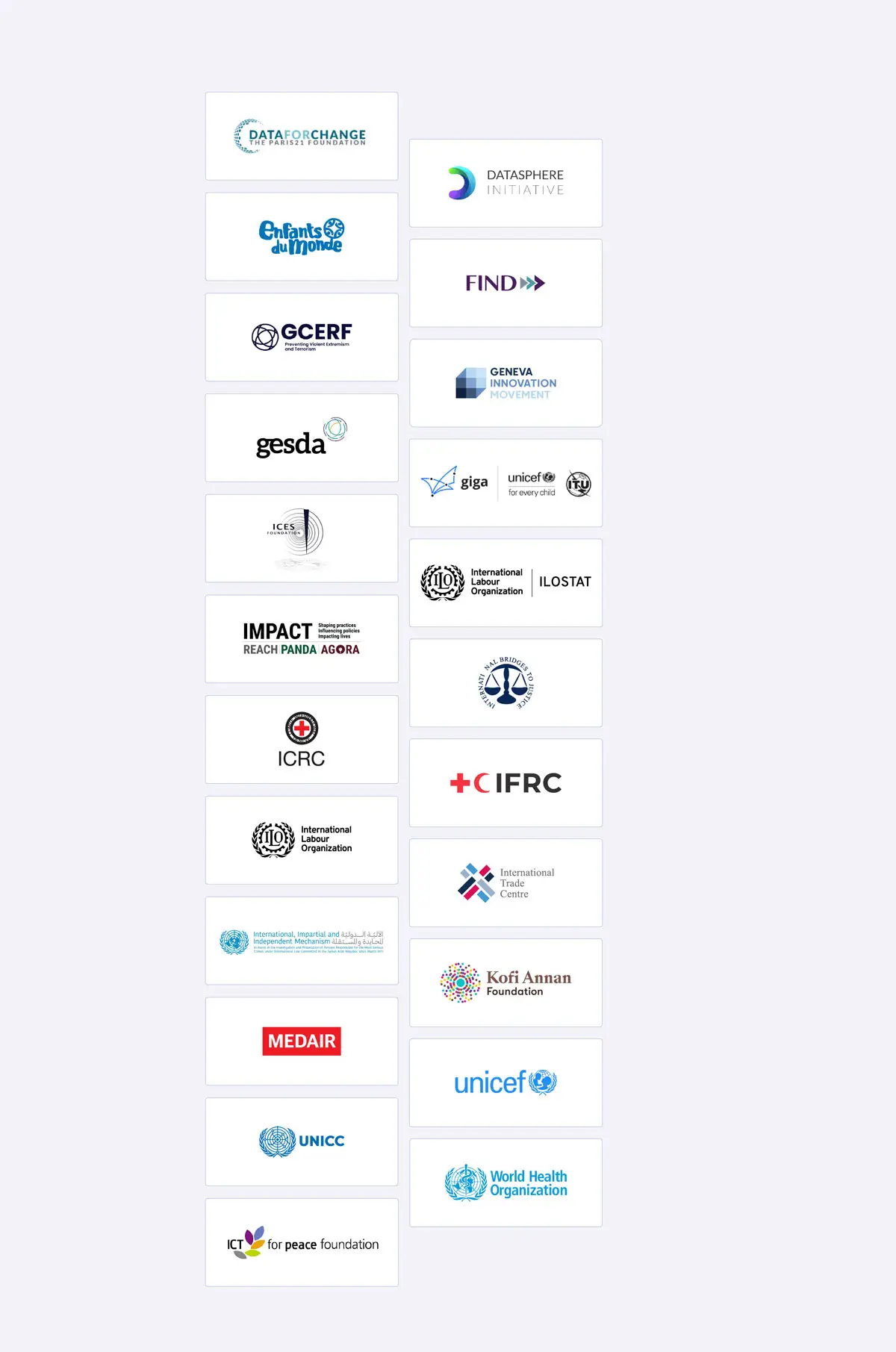
This year, 24 participants from 23 different organizations joined the Geneva AI initiative. They explored how AI can advance their missions and connected with experts and peers from the humanitarian sector. At the AMLD Intelligence Summit, they attended talks on applied machine learning and pitched their projects. With expert support, they turned their pitches into clear and compelling project proposals for funding calls.
The following organizations took part in the 2026 edition:
- International Committee of the Red Cross (ICRC)
- International Federation of Red Cross and Red Crescent Societies (IFRC)
- International Labour Organization (ILO)
- International Trade Centre (ITC)
- International, Impartial and Independent Mechanism (IIIM)
- Kofi Annan Foundation
- Medair
- UNICEF
- United Nations International Computing Centre (UNICC)
- World Health Organization (WHO)
- ICT4Peace
- Data for Change – The PARIS21 Foundation
- Datasphere Initiative Foundation
- Enfants du Monde
- FIND (Foundation for Innovative New Diagnostics)
- GCERF (Global Community Engagement and Resilience Fund)
- Geneva Innovation Movement Association
- GESDA (Geneva Science and Diplomacy Anticipator)
- Giga (UNICEF - Digital Inclusion)
- ICES Foundation
- ILO Department of Statistics (ILOSTAT)
- IMPACT Initiatives
- International Bridges to Justice (IBJ)
Information
2026 Selected Projects
IMPACT Initiatives
AI-Powered Quality Assurance for Humanitarian Research.
Developing an LLM-based assistant that assesses IMPACT’s research outputs against its quality standards and suggests improvements, so trusted evidence reaches decision-makers faster.
Global Community Engagement and Resilience Fund (GCERF)
CLARO, CSO Local AI for Reporting and Operations.
Develop locally deployed, privacy-preserving AI that turns photographed attendance lists and receipts into structured reporting data, freeing civil society staff from manual transcription and improving data quality across GCERF's portfolio.
About
What's Next
If you have an idea, a challenge or a question about what AI could do for your mission, we'd love to hear from you at contact@datascience.ch.